





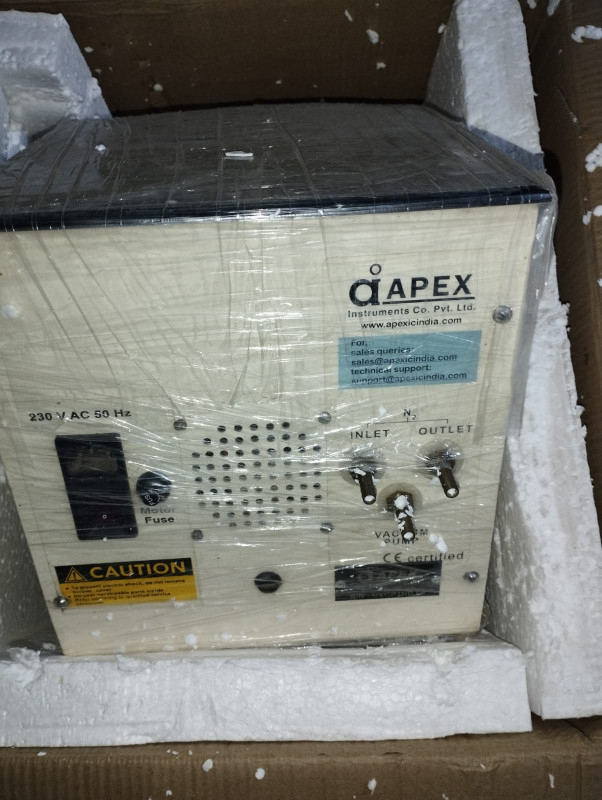
Motor Fuse for Vacuum Pump Everything You Need to Know | Best Rates | Buying Guide | Detailed Tips | Maintenance | FAQ |
Motor Fuse for Vacuum Pump: Everything You Need to Know
If your vacuum pump is the workhorse of your setup, the motor fuse is its guardian. It operates behind the scenes to protect your pump from overloads and short circuits, preventing you from incurring expensive repairs and damage. In this tutorial, we're going to break down everything you need to know about choosing the right motor fuse for your vacuum pump—no technical jargon, just plain, easy-to-follow instructions.
Check the product at Ekra Cargo
What Is a Motor Fuse?
A motor fuse is a safeguard that can interrupt electrical flow if the current becomes too high. It's a watchdog that monitors the circuit. When things get too hot or the current gets too high, the fuse "blows" and cuts power to prevent further damage.
Why Do Vacuum Pumps Need a Fuse?
Vacuum pumps are worked hard—sometimes around the clock. If there is a power surge or if there is an internal motor malfunction, a fuse can:
Prevent motor burnout
Avoid fire hazards
Protect wiring and control boards
Minimize downtime
Installing a proper motor fuse ensures that even
under stress, your vacuum pump remains safe.
Types of Motor Fuses:
Choosing the right fuse starts with knowing your options:
1. Fast-Blow Fuses
React quickly to overloads
Ideal for delicate electronics
Not recommended for most motors
2. Slow-Blow (Time-Delay) Fuses
Can handle short power surges
Perfect for motors that draw extra current at startup
3. Thermal Fuses
React to heat instead of current
Found in small, sealed motors
Symptoms Your Motor Fuse Needs to be Replaced
Vacuum pump won't start
Charred smell around the area where the fuse housing is
Visual damage (smoked, cracked fuse)
Fuse fails continuity test with multimeter
Tip: Always turn off and unplug your device prior to
checking or replacing a fuse.
Top 3 Motor Fuses for Vacuum Pumps (2024-2025
Models)
1. Bussmann FNQ-R-10 – Time Delay Fuse (10A)
Best for: Small and medium-sized rotary vane pumps
Benefits:
UL listed
Handles startup surges well
Durable design
Cons:
A bit pricier than normal fast-blow fuses
2. Littelfuse KLDR Series (5A – 30A Options)
Best for: Laboratory and industrial vacuum systems
Pros:
Large amperage range
Compact size
Reliable under motor loads
Cons:
Needs an identical Littelfuse-compatible fuse holder
3. Siemens Class CC Time Delay Fuse (CC10)
Best for: High-reliability environments
Pros:
Great thermal resistance
Robust construction
Easy to replace
Cons:
May not be compatible with older fuse holders
Buying Guide: Choosing the Right Motor Fuse
Here is a checklist to help you choose the right fuse for your vacuum pump:
✅
Verify Motor Specifications
Voltage
Full-load current (FLC)
Startup surge current (inrush current)
✅
Apply Time-Delay Fuses on Motors
Motors will draw 5–7 times their rated current at startup.
Time-delay fuses won't trip on these brief surges.
✅
Select the Fuse Based on Application
Indoor laboratory pumps demand different protection
than workshop systems with heavy duty.
Think about operating conditions: heat, dust, or
moisture.
✅
Ensure Fuse Holder Compatibility
Fuses come in different physical sizes.
Make sure your fuse holder can accommodate the new fuse.
Installation Tips (Based on Personal Experience)
From many vacuum systems I've been working on, I've seen more downtime caused by fuses not being detected than from motor failure.
Some personal advice:
Label your fuse holders. It's convenient when you're in a hurry with rapid checks.
Be prepared with spares. You won't want to lose operation time waiting for a new fuse to arrive.
Test before replacing. Inspect with a multimeter to see if the fuse really is the issue.
Tip: A fuse is cheap insurance. Blown motor? No way!
Maintenance Tips
To make your motor fuse—and pump—last longer:
Check monthly for wear
Clean around the fuse holder for dirt
Replace old or suspect fuses ahead of time
Check amperage draw on a regular basis
Common Mistakes to Avoid
Using fast-blow fuses in motor applications
Ignoring fuse ratings
Rebuilding with higher amp fuse "just in case" (dangerous!)
Putting a fuse into a defective holder
FAQs
Q: Can I just install any fuse into my vacuum pump
motor?
A: No. You must install a motor-protection-rated fuse, typically a time-delay fuse equal to your motor current ratings.
Q: How do I choose what size of fuse I need?
A: Locate the full-load current rating on your motor. Multiply it by 1.25 to get a safe size, or follow the manufacturer recommendations.
Q: What happens if I put in the wrong fuse?
A: It may blow prematurely (causes downtime) or fail to blow (causes motor damage or fire).
Q: Are fuses better than circuit breakers?
A: Both have their uses. Fuses blow faster and cost less to replace, while breakers can be reset. For small vacuum pumps, you can use fuses instead.
Q: Where do I put in the fuse?
A: Between the power source and the motor, usually in the control box or in-line with the power cable.
Final Thoughts
Choosing the correct motor fuse for your vacuum pump is easy—but it's extremely important. Taking a few minutes to read about the power needs of your pump and choosing the right fuse can cost you hundreds when you need to have repairs.
Whether your equipment is in the form of a small
laboratory pump or industrial-strength gear, good fuse protection keeps your
equipment—and workflow—safe.


Ekracargo.com - Your trusted partner in industrial efficiency, providing a wide range of premium quality spare parts at competitive prices.
Contact Info
- Address: House 54 | Road 14 | Sector 14 | Uttara | Dhaka 1230 | Bangladesh
- Phone: Contact: +8801634736139 (WhatsApp) ,+8801789394669 (WhatsApp)
- Email: info@ekracargo.com